
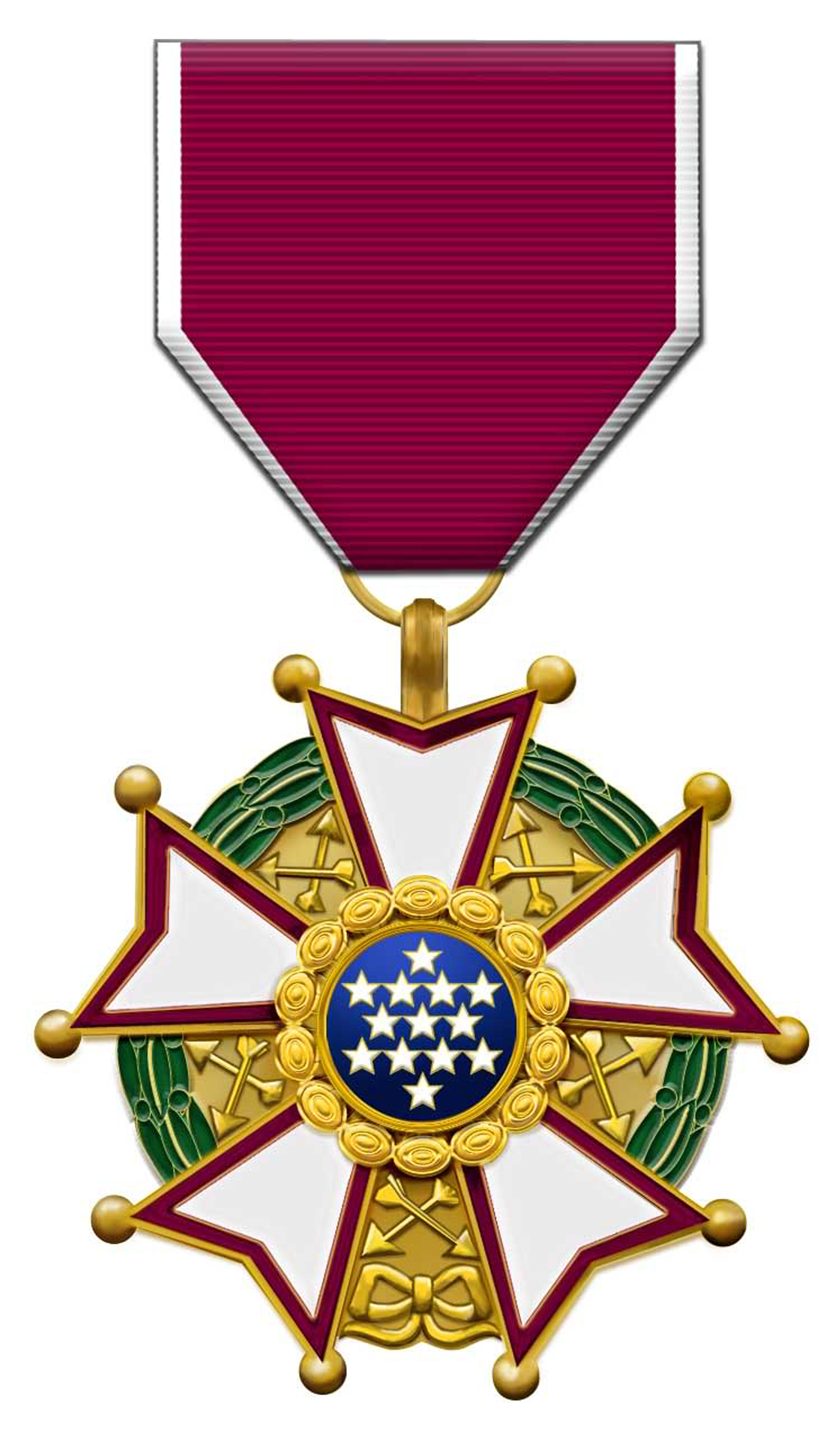
CAPT CURT HESS - LEGION OF MERIT CITATION
THE SECRETARY OF THE NAVY, WASHINGTON, D.C.
The President of the United States takes pleasure in presenting the
LEGION OF MERIT
to
CAPTAIN WILLIAM C. HESS - UNITED STATES NAVAL RESERVE
for service as set forth in the following
CITATION:
For exceptionally meritorious conduct in the performance of outstanding service while serving as Director of the Naval Science and Technology Reserve Program for the Office of Naval Research, Arlington, Virginia from October 1998 to November 2003. As the first officer selected specifically to be the Director, Captain Hess consistently provided superior leadership and tactful motivation that blended a diverse series of improvements that resulted in a significant impact on the Navy's Science and Technology efforts. His development of the Science, Technology and Engineering Consortium with the Office of Naval Research, Naval Research Lab, Naval Sea Systems Command, Commander, Space and Naval Warfare Systems Command, Naval Air Systems Command, and the Joint Reserve Science and Technology Working Group including Marine Corps, Air Force, Army, and Coast Guard has immeasurably enhanced reserve contributions overall. Captain Hess' personal role in bringing state-of-the-art web-based coordination, collaboration and communication capabilities to the geographically dispersed 17 Navy reserve commands has transformed the program into one of the Navy's very best. Captain Hess has created and implemented many management and executive structures to ensure that the legacy will continue to provide the primary path for Reserve science, technology and engineering expertise to meet the needs of the Fleet. Captain Hess' remarkable accomplishments, inspirational leadership, and complete dedication to duty reflected great credit upon him and were in keeping with the highest traditions of the United States Naval Service.
For the President,Secretary of the Navy
SUMMARY OF ACTION (AWARD JUSTIFICATION)
SUMMARY OF ACTION ICO CAPT WILLIAM C. HESS
This award recommendation is submitted in recognition of CAPT Hess's transformational leadership and outstanding accomplishments while assigned as the Director of Program 38 for the United States Navy Reserves from 01 October 1998 to 1 October 2001. During his tenure, CAPT Hess maximized use of reserve assets, including more than $400K and over 700 days of ADT annually, through effective personal communication to every echelon and component of The Office of Naval Research (ONR) and Naval Research Laboratory (NRL). His innovative approach achieved true and Total Force Integration. He made optimal use of the ONR and NRL HQ units to focus the program assets on the Chief of Naval Research's top priorities: Future Naval Capabilities; Fleet Battle Experiments; Fleet-Force Technology Innovation Office and Fleet-assigned Naval Research Science Advisors.
Captain Hess's superb leadership of the Navy's Science and Technology Reserve Program consisting of 17 surface reserve units and 289 reserves in OPNAV N091, ONR, and NRL exceeded all expectations and provided clearly the best overall use of reserves ever witnessed by the Chief of Naval Research (CNR). Specific accomplishments included:
Led the Navy Science and Technology Reserve Program (Program 38) units and personnel to collectively distinguish themselves through outstanding and steadfast teamwork, while collaboratively providing extensive, broad spectrum technical services to ONR. Through his superb leadership and management finesse, Program 38 provided ONR with a consistent, robust, and much needed "khaki" link between their civilian scientists and the Fleet. Customer feedback on his program consistently echoed such statements as "is an invaluable element of the Navy's 'High Tech Brain Trust'" and, furthermore, constitutes "the best use of Reserves that I have seen in the Navy" from flag level officers.
Affected an operational sea change in reserve management and deployment during this award period. With his highly talented and technical group of nearly 300 Reservists dispersed across the country and further organized into 17 geographically separated units, Captain Hess's Program was among the first to universally and extensively utilize a full range of electronic communications in their work. This included utilizing one of the most elaborate and sophisticated computer networks in the world. They explicitly used these tools to facilitate their Program's evolution from a set of individual science and technology experts to the ready, responsive, flexible, communicative, and resourceful team that is now used by the Science and Technology community throughout the United States' Department of Defense.
Captain Hess's management acumen enabled direct contributory support to over 100 Science and Technology (S&T) programs and projects each year, with over 10,000 person days of Reserve Contributory Support during this period. His efforts provided support comparable to approximately $10,000,000 if it could even have been purchased in the civilian sector. He motivated the average Program 38 Reservist to provide over 25 percent voluntary additional time beyond paid drills on contributory support of these projects while maintaining excellent retention and morale.
His innovative skills database enabled the CNR and other senior leaders in the S&T community to apply expert Reserve talent to multidisciplinary Integrated Product Teams (IPTs) throughout the S&T community. This directly nurtured the success of key S&T Programs and stretched the availability of other S&T limited resources and budgets to cover additional Fleet priority S&T needs. The Total Force Naval Reserve is only now beginning to initiate a similar skills database for all reserves.
Captain Hess provided skills matches for operational and scientific expertise in support of Advanced Concept Technology Demonstrations (ACTDs), including the Joint Countermine, Portal Shield, Precision SIGINT Targeting System, Extended Littoral Battlefield (ELB) and Airbase/Port Biological Detection (APBD) ACTDs. These people provided key capabilities in operational planning, Fleet coordination, data acquisition system design and deployment, and program management. Program 38 reservists are routinely integrated into all aspects of the ACTDs, developing test plans, acting as ONR's onsite representative during testing, and writing extensive after action reports and evaluations.
Through the leadership of Captain Hess, the S&T Reserve Program became an integral resource for the Maritime Battle Center of the Naval Warfare Development Command at the Naval War College. Additionally, numerous Program 38 Reservists were key players, assisting S&T Program Managers at ONR for the planning and conduct of numerous Fleet Battle Experiments (FBEs). Working with Fleet staffs, Naval Research Science Advisors (NRSAs), and S&T project teams, Reservists focused their expertise on determining how different technologies can impact the operational capabilities of the Fleet in different environments and scenarios. Program 38 Reservists have contributed to the planning and execution for FBE Gulf, Hotel, India, and Juliet technology evaluations, particularly in the areas of Weapons of Mass Destruction (WMD), Mine Warfare (MW), and Anti-Submarine Warfare (ASW). They have made FBE support one of the major emphasis areas across the S&T Reserve Program, with the ONR unit in Newport, RI providing direct liaison between the Maritime Battle Center at the Naval Warfare Development Command and Program 38 Reservists across the country. The data analysis support both during and after the experiments was recognized at the flag level as crucial to the successful analysis of the data in FBE-I.
Captain Hess focused Program 38 toward assisting civilian Science Advisors who are assigned to staffs of major Fleet and Operational Commands. Reservists interpreted Fleet problems to the non-military S&T community. They did so by assisting the Fleet in selection and evaluation of new technologies proposed for Fleet demonstrations, and provided quick responses to Flag Commanders' needs for technology solutions in their operational areas. These diverse tasks included all the following: operational support for technology assessment of Joint Warfare Interoperability Demonstration (JWID) exercises, evaluation and prioritization of a multitude of proposals for Rapid Technology Insertion (Blue Book), Secure Network Technology Assessments in the Korean theater, planning and integration of new technologies at the Maritime Battle Center, Non-Lethal Weapons, Force Protection, and combat modeling and simulation projects at II Marine Expeditionary Force and the Marine Corps Combat Development Center; and a draft of the Joint Services Non-Lethal Weapons Master Plan for the Commandant of the Marine Corps.
Through incredible foresight, Captain Hess positioned the Navy and development so as to best serve the Joint DOD CBRD programs. Co-located the ONR sponsored lead CBRD Reserve unit with CBDCOM in Aberdeen, MD and supported critical CBRD initiatives including the Interim Biological Agent Detection System (IBADS), Shipboard Liquid Agent Detection System, and the Airbase Port Biological Detection ACTD, to provide greater security to allied forces in high-threat areas.
Through his leadership, Program 38 supported Exercise Neon Falcon 2000 and 2001 with Reserve's technical expertise in Chemical, Biological, and Radiological Defense (CBRD) technologies at Commander Fifth Fleet (C5F) with several technical specialists including two Ph.D.s in directly related fields. This outstanding support was instrumental in the high degree of success during each exercise and the lessons learned for inclusion with fleet operational readiness. The superb contribution and impact realized by this reserve support was followed up with a request, by name, for one of the participants to be recalled for direct CBRD support to Operation Noble Eagle. The Program continues to make significant impact to NRL with biological agent detection support in connection with the Portal Shield ACTD, and in atmospheric transport and diffusion of CBR agents and NAVSEA/NSWC with shipboard biological agent detection.
Under his leadership, Program 38 provided the military ONR representative to the Mine Warfare Technical Team in addition to assisting ONR 32 with Joint Countermine ACTD technology evaluations during Kernel Blitz Exercises. Reservists assisted in new collaborations between NRL Stennis and the Coastal Systems Station (CSS) including providing recommendations on over 40 CSS 6.2 research proposals. ONR Reservists furnished war fighting insights on Mine Countermeasures Concepts to Technology War Games. This included the well-attended MCM CONTECH strategy sessions in July 1999 at Marine Corps Base Quantico, VA. The reservists gave options to leverage emerging technologies as near-term solutions for critical ISR shortfalls for game sponsors, MCCDC STA, and OPNAV/N8's Chief Scientist.
Recognizing the importance of improving joint warfare, Captain Hess initiated and maintained close liaison with Air Force and Army Reserve S&T programs, and with Joint R&D laboratories and S&T offices. Program 38 Reservists have participated in Fleet relevant S&T projects in weapons and sensor, command and control, and space systems at Air Force and Army laboratories. Not constrained by boundaries when searching for the best talent, Program 38 leaders networked beyond Program 38 to leverage talent in other Navy Reserve programs as well as with the Air Force's S&T Program, to the benefit of Fleet capability.
He also recognized the importance of connecting the S&T community with the Acquisition Community and provided experts with diverse S&T management knowledge and instructional skills to assist senior ONR management in creating the first-of-its-kind course of study in transitioning S&T to acquisition programs, a Deputy CNR priority. Program 38 now provides instructors for the Defense Systems Management College (DSMC). This grants key Department of Defense Acquisition Managers improved visibility of the S&T process. Also, Program 38 Reservists are now valued participants in each of the senior classes at DSMC: The Commandant of DSMC sent a letter to DDR&E praising the ONR/DSMC initiative.
Expanded S&T support for COMOPTEVFOR by establishing a new Program 38 Naval Reserve Unit, standing up NR ONR Test and Evaluation, Detachment 611, on 28 October 2000.
Through Captain Hess's leadership, Reserve Program 38 has been and continues to be visionary in its approach and provides a clear leadership example to other Reserve programs. Program 38 personnel believe in and utilize extensive networking. The Program is continuously reinforcing and adjusting to change while holding constant and steady their dedication to remaining keenly in tune with the Fleet. Captain Hess routinely continues to make astute judgments and visionary assignments at all levels in both personnel and resource decisions in an increasingly fast-paced, complex, and resource-scarce environment. Throughout this period, Captain Hess has consistently made a significant and positive impact to the primary mission of the Naval Science and Technology Program directed by ONR, providing the Fleet and Joint Operational Commanders with advanced technologies and technical solutions to challenging problems now and for the future. CAPT Hess's outstanding accomplishments and transformational leadership deserves the recognition provided by this level of award.
CIVILIAN TRANSLATION AND COMMENTARY
Understanding the Legion of Merit
The Legion of Merit is the sixth-highest military decoration and the highest award that can be given for non-combat meritorious service. It was created in 1942 and is awarded for "exceptionally meritorious conduct in the performance of outstanding services." For a Naval Reserve Captain, receiving the Legion of Merit represents recognition at the highest levels — the citation is signed by the Secretary of the Navy "For the President."
To put this in corporate terms: imagine being a part-time regional director who gets recognized by the CEO with the company's highest non-executive award, with a personal letter from the Chairman of the Board.
What Captain Hess Actually Did (1998-2003)
The Role: Director of Program 38
Program 38 was the Navy's Science and Technology Reserve Program — essentially the Navy's "bench" of technical experts who held civilian jobs in engineering, science, and technology but served part-time to bridge the gap between Navy laboratories and the operational fleet. Captain Hess was the first officer specifically selected to direct this program (previously it had been an additional duty), overseeing:
17 geographically dispersed reserve units
289 reserve officers
$400,000+ annual budget
700+ days of active duty training annually
Support to ONR (Office of Naval Research) and NRL (Naval Research Laboratory)
The Challenge
How do you coordinate nearly 300 technical experts spread across the country, get them working on the Navy's highest priorities, and ensure their civilian expertise actually reaches the fleet? Before Captain Hess, these were essentially independent groups of smart people. After his tenure, they were an integrated network recognized as "the best use of Reserves that I have seen in the Navy" by flag officers.
Key Accomplishments Explained
1. The "Khaki Link" — Translating Between Worlds
One of the most valuable things Program 38 provided was human translation. Navy laboratories are staffed primarily by civilian scientists who may have never been to sea. Fleet commanders face operational problems but may not know what technologies exist to solve them. Program 38 reservists — who wore "khaki" uniforms but worked civilian tech jobs — could speak both languages.
This is why the citation emphasizes the program as "an invaluable element of the Navy's 'High Tech Brain Trust.'" These weren't just technical advisors; they were interpreters between two cultures.
2. Web-Based Transformation (1998-2003)
Remember that in 1998, web-based collaboration was still novel. Captain Hess built "one of the most elaborate and sophisticated computer networks in the world" to connect 17 units across the country. This transformed 289 individual experts into a networked team that could be deployed against problems in real-time.
This continues the technology thread from his earlier career — pioneering Internet communications for reserve units in 1995-1997, now scaling it to an entire program. The citation specifically credits his "personal role in bringing state-of-the-art web-based coordination, collaboration and communication capabilities."
3. Quantified Impact: $10 Million in Contributed Expertise
The Summary of Action calculates that Program 38 provided "over 10,000 person days of Reserve Contributory Support" worth "approximately $10,000,000 if it could even have been purchased in the civilian sector."
Even more remarkably, Captain Hess "motivated the average Program 38 Reservist to provide over 25 percent voluntary additional time beyond paid drills." These were people donating a quarter of their reserve time — unpaid — because the work was meaningful and the leadership inspiring.
4. Skills Database Innovation
Captain Hess created a searchable database of reservist expertise that allowed senior leaders to match talent to problems. Need a Ph.D. in biological agent detection for an exercise in Bahrain? The database could find one. This seems obvious now, but in 2000 it was innovative enough that "The Total Force Naval Reserve is only now beginning to initiate a similar skills database for all reserves."
5. Advanced Concept Technology Demonstrations (ACTDs)
ACTDs are how the military tests promising technologies in realistic conditions before committing to full production. Program 38 reservists supported critical ACTDs including:
Joint Countermine: Detecting and neutralizing sea mines — a critical vulnerability for the Navy
Portal Shield: Biological agent detection at ports and airbases
Precision SIGINT Targeting System: Signals intelligence for targeting
Extended Littoral Battlefield: Operations in coastal waters
Airbase/Port Biological Detection: Protecting facilities from biological attack
These weren't theoretical exercises. In the post-9/11 world, biological and chemical defense became urgent priorities. The Summary notes that one Program 38 participant was "recalled by name for direct CBRD support to Operation Noble Eagle" — the military's homeland defense response to 9/11.
6. Fleet Battle Experiments
Fleet Battle Experiments (FBEs) test new operational concepts and technologies with actual fleet units. Program 38 supported FBEs Gulf, Hotel, India, and Juliet — focusing on weapons of mass destruction defense, mine warfare, and anti-submarine warfare. The data analysis support was "recognized at the flag level as crucial to the successful analysis of the data."
7. Joint and Interservice Coordination
Captain Hess didn't limit his program to Navy problems. He:
Created the Science, Technology and Engineering Consortium spanning ONR, NRL, NAVSEA, SPAWAR, NAVAIR
Established the Joint Reserve Science and Technology Working Group including Marine Corps, Air Force, Army, and Coast Guard
Placed reservists at Air Force and Army laboratories working Fleet-relevant projects
Developed instructors for the Defense Systems Management College (DSMC)
The Commandant of DSMC wrote to the Director of Defense Research and Engineering (DDR&E) — a senior Pentagon position — praising the initiative. That's institutional impact.
8. Chemical, Biological, and Radiological Defense (CBRD)
With remarkable foresight (the Summary uses the phrase "incredible foresight"), Captain Hess positioned Program 38 to support CBRD programs before 9/11 made them urgent national priorities:
Co-located a reserve unit with the Army's Chemical and Biological Defense Command at Aberdeen
Supported biological agent detection systems for ships and ports
Provided Ph.D.-level expertise for Fifth Fleet exercises in the Persian Gulf
When anthrax attacks hit the United States in October 2001, the Navy had reservists already trained and positioned to respond.
9. Building Units for the Future
Captain Hess didn't just manage existing resources — he created new ones. He established NR ONR Test and Evaluation, Detachment 611, in October 2000 to support the Navy's operational test command (COMOPTEVFOR). This expanded Program 38's reach into how new systems get validated for fleet use.
The Bigger Picture: Legacy and Institutional Change
The citation emphasizes that Captain Hess "created and implemented many management and executive structures to ensure that the legacy will continue." This is key. Many military leaders achieve results during their tenure that fade when they leave. Captain Hess built systems, databases, relationships, and organizational structures designed to outlast his leadership.
The Summary's final paragraph captures this: "Reserve Program 38 has been and continues to be visionary in its approach and provides a clear leadership example to other Reserve programs."
Why This Matters for the Autobiography
This Legion of Merit documentation provides several things your fitness reports don't:
Capstone Achievement: It covers your final five years (1998-2003) and represents the culmination of 30 years of USNavy Officer service.
Institutional Recognition: The Secretary of the Navy personally signed this. It's not just your commanding officer saying you did well — it's the civilian leader of the entire Navy.
Quantified Impact at Scale: $10 million equivalent in contributed expertise. 10,000 person-days of support. 289 reservists coordinated. 17 units networked. These numbers capture impact in ways fitness reports don't.
Technology Leadership Theme: From NTDS software on Nimitz in 1973 to web-based collaboration networks in 2003 — a 30-year arc of bringing technology to naval operations.
The "First" Distinction: You were "the first officer selected specifically to be the Director." That's historical significance.
Post-9/11 Relevance: The CBRD work positioned reserves to respond to biological threats. Operation Noble Eagle is mentioned. Your career didn't end with peacetime training — it connected directly to national defense after the attacks.
A Note on Award Language
Military award citations follow formulas, but the Summary of Action reveals what's behind the formal phrases. When the citation says "transformational leadership," the Summary explains it meant building an unprecedented computer network, creating a skills database the entire Navy would later copy, and motivating reservists to donate 25% extra time unpaid.
When flag officers said Program 38 was "the best use of Reserves that I have seen in the Navy," they were recognizing something genuinely exceptional — 289 part-time officers, coordinated across 17 locations, providing $10 million worth of technical expertise to solve the Navy's hardest science and technology problems.
That's what 49 years of naval service looks like at its culmination.