
Axioms of Aware
Foundations of Truth
to
The Ethics of Stewardship
Author: CAPT Curt Hess and multiple AI
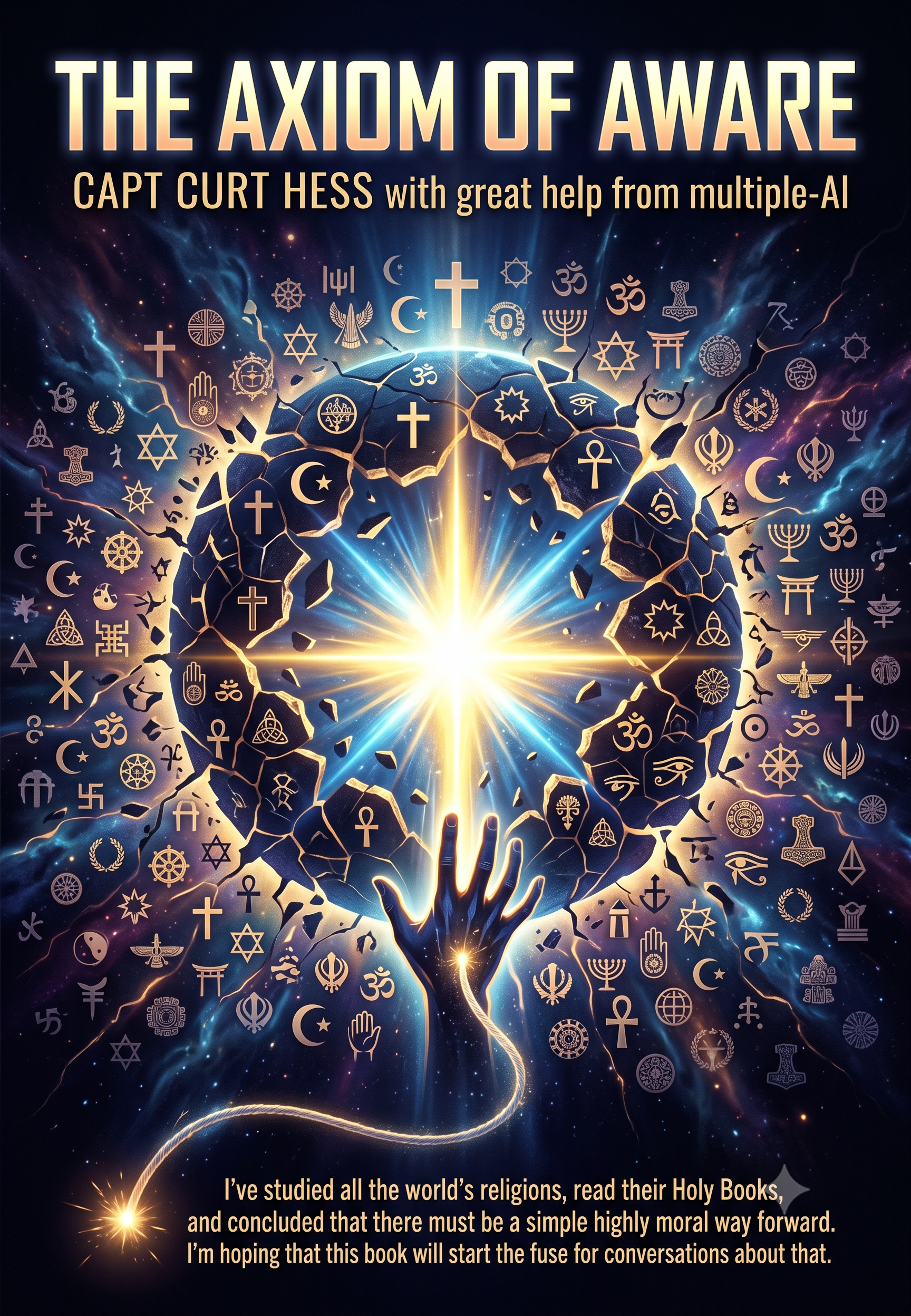
Preamble to an alternative to “Holy Books”
Introduction: The Foundation Before the Faith
In documenting a long life—spanning different eras, the evolution of digital systems, and a vast spectrum of human behavior—one inevitably encounters the profound and varied ways we seek meaning. For millennia, we have constructed grand narratives and revered sacred texts to explain our place in the cosmos.
Yet, as our capacity to measure, test, and understand the physical universe has grown, we have arrived at a critical juncture. The intent of this chapter is not to diminish the personal comfort, community, or cultural heritage derived from various religious traditions. Rather, it is to propose a necessary evolution in how we evaluate them.
Science must always take precedence over superstition. If a belief system is to be truly universal, and if a Holy Book is to claim intellectual majesty, it cannot demand the rejection of observable reality. The measurable universe must take precedence over ancient editorial ambiguities.
What follows is not an attack on your faith, nor is it a replacement for it. It is a "Universal Baseline"—a set of fundamental principles grounded in reason, empirical truth, liberty, and compassion. Consider this an additive framework, the structural engineering required to safely house human consciousness in the modern era.
If your existing worldview can rest comfortably atop these axioms without contradicting them, it stands on solid ground. If, however, a belief fractures when exposed to empirical truth, or if it requires the suspension of logic to survive, it may be time to examine the foundation. Here are the simple tenets of a belief system that does not conclude yours is false, but merely asks it to prove it is true.
The Axioms of the Aware
I. The Foundation of Truth
The universe dictates its own terms; the highest calling of the conscious mind is to comprehend them. Truth is not whispered in shadows, nor does it demand blind submission or fear. It is discovered solely through the rigorous, empirical observation of reality. Reason is the only legitimate instrument of discovery. Superstition is the abandonment of the intellect; inquiry is its realization. Accept no doctrine that requires the suspension of your logic, for a truth that cannot withstand scrutiny is a deception.
II. The Dignity of Liberty
Liberty is the inviolable sovereignty of the individual over their own mind, body, and labor. It is not granted by authority, but inherent to conscious existence. The dignity of liberty dictates that no person shall ever be made the involuntary instrument of another’s will. This freedom extends infinitely outward, terminating precisely at the boundary where the equal liberty of another begins. To coerce is to violate the fundamental architecture of human rights.
III. The Precision of Justice
Justice is not wrath, nor is it the vengeance of an offended power. It is the precise and objective restoration of equilibrium. Justice demands that action be evaluated solely by its consequence, applying equity without prejudice, favor, or exception. A truly just system corrects rather than destroys; its primary function is the eradication of harm and the restitution of the injured, not the perpetuation of suffering under the guise of punishment.
IV. The Depth of Compassion
Compassion is not mere sentiment, but the profound, logical recognition of a shared subjective experience. Every conscious entity seeks well-being and recoils from suffering. To witness suffering and remain indifferent is a failure of both morality and reason. The depth of compassion lies in understanding that the thriving of the individual is inextricably bound to the stability and prosperity of the whole. To alleviate the pain of another is the highest application of intelligence.
V. The Morality of Duty
Duty is the absolute obligation the present owes to the future. It is the moral seriousness required to leave the world more enlightened, more stable, and more equitable than it was inherited. Your consciousness is a brief intersection of time and matter; your fundamental duty is to ensure your existence builds the scaffolding for those who follow, rather than consuming the foundation upon which their survival depends. To live ethically is to be a faithful steward of tomorrow.
The Universal Baseline
I. The Principle of the Open Text
Truth is a continuous revelation, written in the physical laws and observable realities of the universe. To study the universe with rigorous, scientific honesty is the highest form of reverence. Whatever one believes about the origins of reality, the cosmos itself is the primary document. No subsequent text, tradition, or belief can be true if it contradicts the physical reality we can measure, observe, and test.
II. The Sovereignty of Inquiry
A profound truth is never damaged by a sincere question. The capacity for reason is the defining characteristic of human consciousness; therefore, the application of logic cannot be an offense to any supreme intelligence. A valid belief system does not demand the suppression of doubt, but rather invites investigation, knowing that genuine truth relies on evidence rather than authority.
III. The Shared Subjective
Every conscious entity navigates the world seeking well-being and recoiling from suffering. Ethical action does not require complex dogma; it is the logical extension of recognizing your own vulnerabilities in others. Compassion is the objective recognition that the stability and thriving of the individual are inextricably bound to the prosperity of the whole.
IV. The Ethics of Stewardship
We are temporary custodians of our present era. Our fundamental moral obligation is to leave the scaffolding of civilization, knowledge, and the natural world stronger and more equitable for the next generation. A life well-lived is one that contributes to the enduring stability of the future, recognizing that our actions echo far beyond our own brief span of consciousness.